Sound & texilte
A text by Victor Guaita
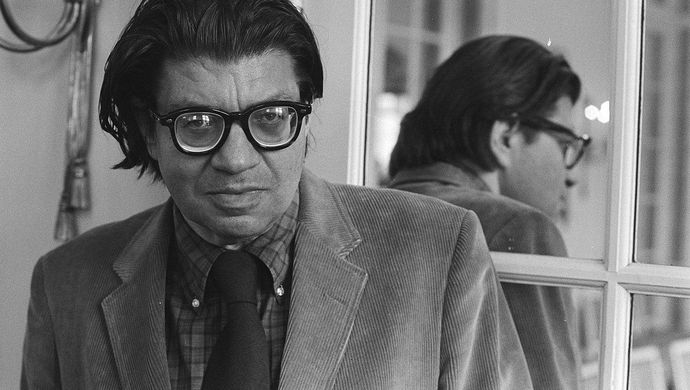
Morton Feldman stands as one of the most influential composers of the 20th century, renowned for his unique approach to sound that transcends time and defies conventional boundaries of musical form. His 'String Quartet No. 2', often described as the apex of his
chamber works, exemplifies his profound ability to weave intricate patterns of sound into a seamless fabric. This composition has only been staged once in Belgium and remains a rare gem in the classical music world–an experience in which time itself seems to stretch and
dissolve, drawing listeners into a space of pure presence.
Feldman's deep connection to the visual arts is integral to understanding his music. He was close friends with legendary painters such as Rohtko, de Kooning, Guston, and Pollock, and his work was profoundly influenced by abstract painting—particularly its sense of stasis and timelessness. His compositions often evoke the same sense of colour and texture that characterize visual art, with its compositions perceived as a kind of auditory canvas. Feldman was particularly fascinated with the concept of patterns—how they emerge and transform over time.
A unique thread in this exploration of sound and visual arts is Feldman's engagement with textile art. He was an avid collector of Bakhrati rugs, which reflect his deep connection to the patterns and textures found in fabric. His music, when viewed through the lens of textile art, can be seen as an abstraction of traditional weaving techniques—a canvas of sound that unfolds slowly, meticulously, with imperfect symmetry. The patterns in his music, much like the threads in a tapestry, are woven together to create an intricate and expansive whole of imperfect symmetries, a process that mirrors the art of weaving itself.
This collaboration between sound and textile finds a deep resonance in Flanders, a region historically renowned for its rich textile industry. The banks of the Leie River, stretching from Ghent to Kortrijk, have long been a centre of textile craftsmanship, from the cultivation of high-quality flax to the production of fine linen fabrics. The region's textile heritage offers fertile ground for reimagining the intersection of sound, colour, and patterns. By grounding this performance in Flanders' long-standing connection to the textile industry, we bring the project into dialogue with the place itself, intertwining the creative traditions of both the past and the present. Local textile industries, such as B&T Textilia, are sponsoring the materials—linen yarn—that will be used in the performance, further rooting the project in the region's textile legacy.
In this performance, we propose a groundbreaking fusion of sound and textile, where the act of weaving becomes an integral part of the musical experience. Prior to the performance, Feldman's score will be transformed into a weaving script, with patterns and motifs that the weaver will follow as the music unfolds. The loom used in this performance will be a specially designed instrument of scenographic proportions—an abstraction of the traditional backstrap loom. Silent in its operation, the loom serves as a sculptural element that deeply engages with the themes of connectivity and interwoven space-time. It offers the audience a visual and tactile counterpart to the sounds of Feldman's 'String Quartet No. 2', creating a palpable sense of process that complements the unfolding music. The weaver's quiet, deliberate movements echo the patience and intricacy inherent in both the weaving process and the music.
The weaving process itself, a slow and deliberate craft, mirrors the temporal nature of Feldman's music—both practices demand patience and attention to detail, with each step building toward an eventual, unforeseen culmination. At the end of the performance, the woven fabric is unveiled, and only then do the audience, the musicians, and the weaver discover the final result. This ritual, known as tombée de métier, speaks to the idea of completion and revelation, a moment where the long, contemplative process of both music and weaving comes to fruition.
Since the art of weaving by hand and that of performing music have different temporalities and the extreme dimensions of the loom—whose warp will be over 20 meters long—the weaver will only complete the entire weaving script over the course of several performances. Once it is completed, the fabric might be exhibited in art galleries as a trace of the live performance.
Through this collaboration between sound and textile, we invite the audience to experience the delicate balance between time, sound and space. Morton Feldman's 'String Quartet No. 2' will be woven into the fabric of this performance, creating a rich, multisensory tapestry where the boundaries between music and visual art dissolve, leaving only the profound experience of art in its purest, most interconnected form.