


Eight voices, one band: Roomful of Teeth explores the boundaries of the human voice
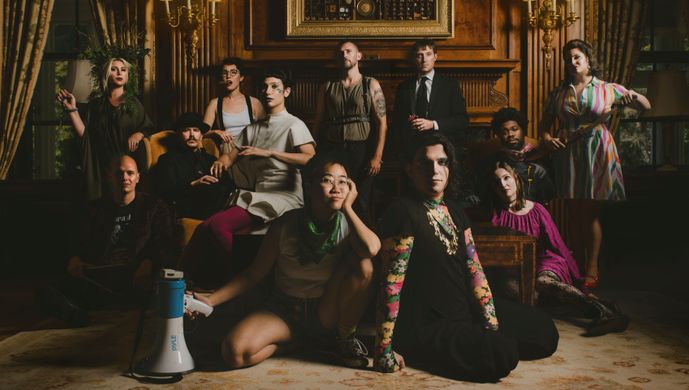
For almost two decades, the artists of Roomful of Teeth has been pushing the boundaries of what a voice can be. Not a vocal ensemble in the traditional sense, but a group of eight singers operating as a band. At Music Centre De Bijloke, they present a cross-section of their fascinating universe, featuring works by Caroline Shaw, Bec Plexus, Leilehua Lanzilotti and Gabriel Kahane. Ahead of the concert, we spoke with singer Steven Bradshaw, who has been a member of the ensemble since 2012.
A collective approach
Roomful of Teeth is often described as a vocal ensemble, but you prefer to refer to yourselves as a band. Why?
"Because that is really how we function in many ways. There are eight voices, but no conductor or fixed leader standing at the front making all the decisions. Everyone brings their own ideas, expertise and personality to the table. Rehearsals are highly collaborative: together, we search for the best way to bring a piece to life. That feels much more like a band than a classical ensemble. Besides, almost everything we perform is written specifically for us. As a result, we develop a very personal relationship with the repertoire. It’s our repertoire encoded with our sonic signature.”
That collective approach seems essential to the ensemble’s identity.
"We think like, tour, and experience music like a band. That was never formally defined; it simply developed organically. We exist somewhere between a contemporary ensemble and a travelling group of musicians, spending night after night on the road giving performances that only we can deliver."
A central work on the programme is a selection from Caroline Shaw’s ‘Partita for 8 Voices’. What does that piece mean to Roomful of Teeth?
"There is a Roomful of Teeth before ‘Partita’ and a Roomful of Teeth after it. The work earned Caroline the Pulitzer Prize, the album on which it appeared won a Grammy, and for us it completely changed the course of the ensemble. One couldn’t overstate how important it was."
You have been performing the work for more than a decade. Does a piece like that continue to evolve?
“Enormously. The 2013 recording captures us as a group still discovering what the piece could become. Today, that music was transformed by its performance-life: we discovered new things in it, and discovered what it wanted to be in some sense. The tempos have changed, the character has changed, and the personnel has changed in part. It sounds very different today in comparison to the original recording. It’s gratifying to watch audiences familiar with the recording react to the strengthened impact of the live performance.”
A challenging sound world
You always perform with amplification, something rather unusual in the world of contemporary chamber music.
“For us, it is fundamental. Roomful of Teeth is often described in terms of its voices, but I think a crucial part of our project revolves around the question of what amplification can mean within experimental vocal music. Microphones make it possible to reveal the tiniest details. A whispered sound can compete sonically with a powerful outburst occurring simultaneously. This creates new possibilities in the sonic landscape of our work. Our sound engineer is a ninth band member, helping shape what the audience hears.”
Also on the programme is Leilehua Lanzilotti’s ‘On Stochastic Wave Behavior’…
“That piece has become an audience favorite within our repertoire in recent years. It starts from the apparent randomness of ocean waves, while simultaneously revealing how larger patterns emerge from that chaos. Lanzilotti connects these ideas to the nature and culture of Hawai‘i. You hear references to marine life, children’s games and collective rituals. Towards the end, a beautiful, almost incantatory motion develops in a mantra like phrase that translates to “Your turn… and now mine”
… and the premiere of a work by Dutch composer Bec Plexus.
“We are tremendously excited about that. The piece is called ‘T'ng Kl'ng’ and emerges from a fascination with the physical meaning of sounds. Bec wrote that even a single vowel can evoke a specific emotional world. An ‘oo’ feels different from an ‘oh’; a ‘pa’ different from a ‘ka’. From that idea, she created a work that constantly balances between playfulness and wonder. She compares it to a glass mobile in which rays of light refract and reflect. You can hear that image resonating throughout the music.”
What can the audience ultimately expect from this evening?
“Each work embodies a different aspect of what the voice is capable of, yet together they form a a cohesive sonic tour of our creative universe. Our signature work followed by the compositions we’ve been working on recently that we love. We are looking greatly forward to performing these works to the audiences in Ghent for the first time!”