

Connected by nostalgia
William Dougherty
Nostalgia can be both a social disease and a creative emotion, a poison and a cure. The dreams of imagined homelands cannot and should not come to life. They can have a more important impact on improving social and political conditions in the present as ideals, not as fairy tales come true. Sometimes it’s preferable (at least in the view of this nostalgic) to leave dreams alone, let them be no more and no less than dreams, not guidelines for the future. Acknowledging our collective and individual nostalgias, we can smile at them, revealing a line of imperfect teeth stained by the ecologically impure water of our native cities.
—Svetlana Boym, The Future of Nostalgia (2001)
This work is inspired by Svetlana Boym’s writings on nostalgia. I am fascinated by how, as Boym writes, “nostalgia can be both a social disease and a creative emotion, a poison and a cure. ” Nostalgia is a potentially dangerous double-edged sword. It can bring communities together and at the same time exclude people and ideas perceived as newcomers or as incompatible with shared ideas about the past. Boym even cautions readers against bringing “the dreams of imagined homelands” to life. And this got me thinking: how do audio recordings participate in nostalgia-making, in preserving “the dreams of imagined homelands,” and potentially bringing them to life?
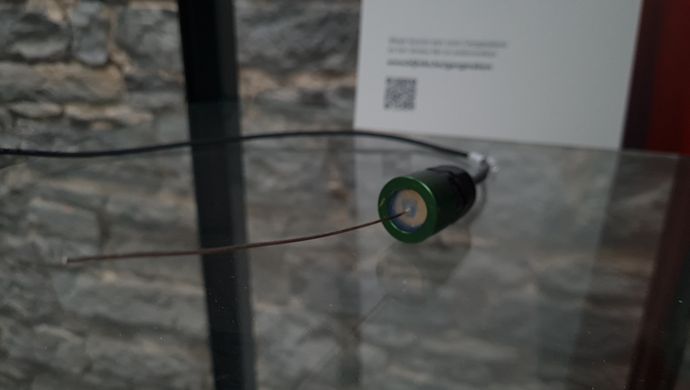
This work sets out to explore the dreams of imagined homelands through recorded sounds. At the center of the work is a damaged 1907 wax cylinder recording of the Edison Mixed Quartet singing Home, Sweet Home . This recording is played on an amplified 1906 Edison Wax Cylinder Phonograph Player during the work. Home, Sweet Home was originally composed by Englishman Sir Henry Bishop and was adapted from an Italian folk tune. Thetext was written by American actor and dramatist John Howard Payne for his 1823 operea Clari; or the Maid of Milan; and the song helped make Payne’s operea an instantaneous success. Home, Sweet Home went on to become a popular hit across the United States. The lyric’s pastoral imagery of a return to home would have certainly appealed to an American populace of largely first- and second-generation immigrants. The tune created such a sense of nostalgia in listeners of the time, that performances of it were reportedly forbidden in Union Army camps during the American Civil War (1861-65) because officers feared an avalanche of desertions. (It is important to note too, that, at the time, immigrants and sons of immigrants made up 43% of the US armed forces.) Home, Sweet Home had such nostalgic appeal, that at one point, when it was performed in adjacent army camps during the American Civil War, it created an immediate outpouring of kinship and camaraderie amongst the soldiers of the two warring armies. In his book Serving the Republic: Memoirs of the Civil and Military Life of Nelson A. Miles (1911), Union Army General Miles writes:
Late in the afternoon our bands were accustomed to play the most spirited martial and national airs… to be answered along the Confederate lines by bands playing, with equal enthusiasm… These demonstrations frequently aroused the hostile sentiments of the two armies, yet the animosity disappeared when at the close some band would strike up that melody which comes nearest the hearts of all true men, "Home, Sweet Home," and every band within hearing would join in that sacred anthem with unbroken accord and enthusiasm.
I have chosen to juxtapose this wax cylinder recording of Home, Sweet Home with two personal field recordings that I made with my smartphone—the first is of children playing in Anne Frank Memorial Park in the heart of Paris and the second is of cows roaming freely in the Alps near Leukerbad, Swierland. These are played from loudspeakers at various moments throughout the work. I am interested in how recording technologies—from my smartphone to the Edison Wax Cylinder Phonograph—fail to “capture” and “reproduce” sounds. As with any object that seeks to represent a specific moment in time, recordings are the result of millions of cultural, perceptual, and personal value judgments about what is worth preserving. They are an assortment of cultural and technological artifacts that result from this constructed process of conservation, of storytelling and world-making. I am therefore compelled to ask: What can these recordings tell us about their particular time, place, and culture? And despite all the distortions, can we hear the traces, the stories of the people on the other end?